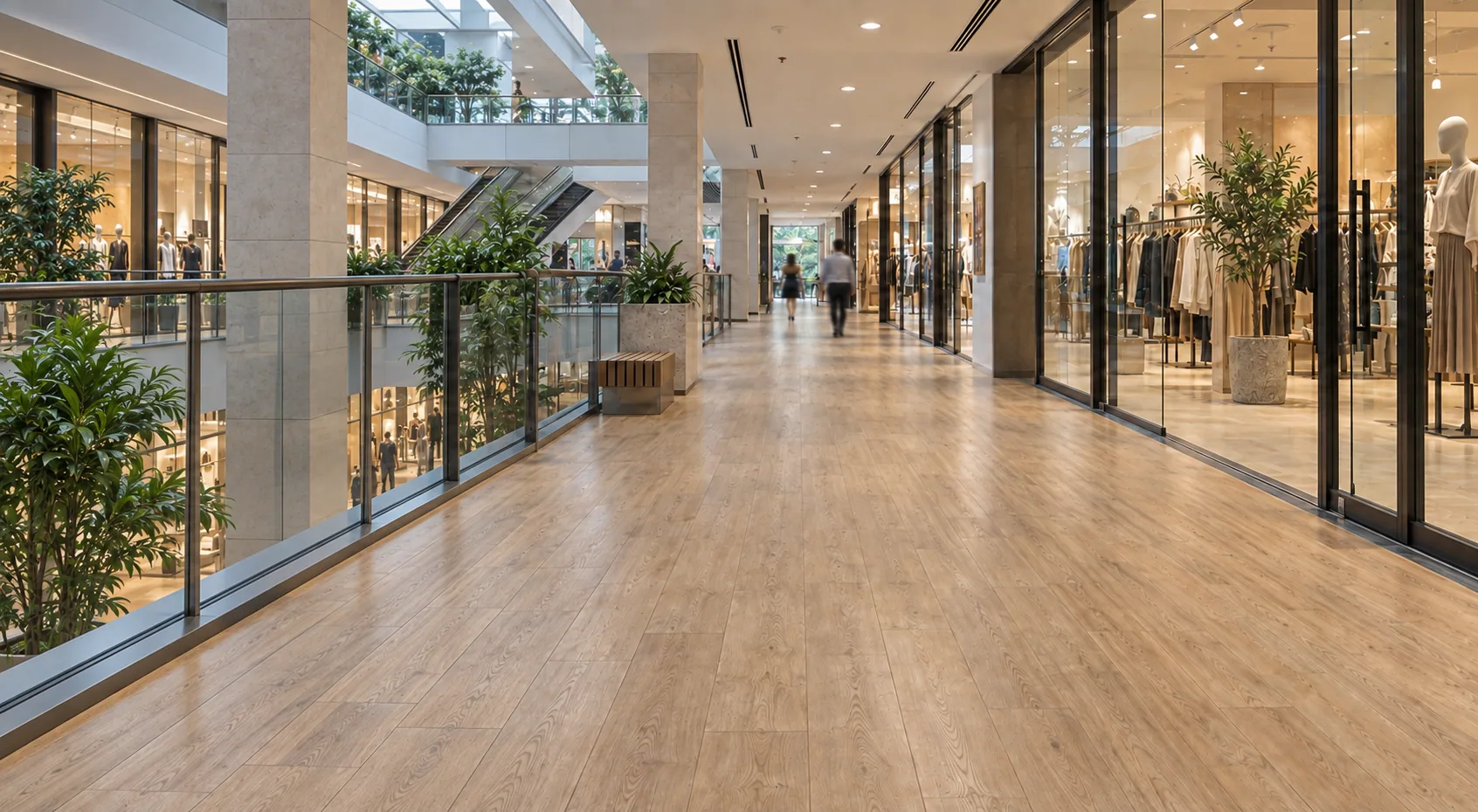
Commercial specification
What fire rated and SCDF compliant actually mean for commercial vinyl flooring
Less than a datasheet usually implies. The flame spread classes everyone quotes are a wall and ceiling system. A vinyl floor is regulated as a plastic, and the first question the Fire Code asks about it is thickness, not class.
The short answer
Two separate rules, and the famous one does not govern your floor
The Class 0 to Class 4 flame spread system that most people mean by fire rated is set out in Clause 3.13 of the Fire Code, and the table that carries the requirement is titled minimum flame-spread classification of finishes to wall, column, beam and ceiling. Floors are not in its scope.
A vinyl floor is regulated somewhere else entirely. Vinyl is a plastic, Clause 3.15.15 says that walls, ceilings, floor, roof and finishes shall not contain any plastic material unless it complies with Clause 3.15.19, and Clause 3.15.19 asks about thickness before it asks about anything else. At or below 10mm, or 20mm in sprinkler-protected premises, the Code does not require the fire tests in Table 3.15A at all. Above that, the product has to pass three separate test categories, and the class it then needs is decided by your building rather than by the product.
All clause references on this page are to the Fire Code 2023, as published by SCDF and read on 13 September 2026.
What the code says
Six things that are true at once
Most of the confusion in this market comes from mixing these up. Each one is checkable on SCDF's own site, and each one below links to the clause or table it came from. The code is amended on a rolling basis, so a clause reference without a date is not really a reference.
-
The flame spread classes are a wall and ceiling system
Clause 3.13 sets the Class 0 to Class 4 system, and Clause 3.15.10 applies it to the surfaces of walls and ceilings. SCDF's own explanation of Clause 3.13.2 describes BS 476 Part 7 as a method of classification appropriate to wall and ceiling linings. The governing table, Table 3.13A, is titled for finishes to wall, column, beam and ceiling, and floors do not appear in its scope.
Clause 3.13 on SCDF -
Vinyl is caught by the plastics clause instead
Clause 3.15.15 reads: walls, ceilings, floor, roof and finishes shall not contain any plastic material, unless the plastic material complies with the requirements stipulated in Cl.3.15.19. Vinyl is a thermoplastic and sits inside the Code's own definition of plastic, and SCDF's illustration of Clause 3.15.19 gives PVC as an example. Confirm a specific product's classification with the certification body rather than assuming it from the category name.
Clause 3.15 on SCDF -
Thickness is the first question, not class
Table 3.15D, for uncovered plastic floor finishes, allows material thickness not exceeding 10mm with no further fire test required, and notes that in sprinkler-protected premises material not exceeding 20mm can be exempted from the tests in Table 3.15A. Above that threshold the material is allowed only if it passes test categories A, B and C. Table 3.15F carries the same rows for covered plastic floor finishes, with one addition: where the overlay is non-combustible and at least 25mm thick, test category C is exempted.
Table 3.15D on SCDF -
Three test categories, and two accepted routes
Table 3.15A sets category A for toxicity emission, category B for smoke density and category C for flame spread, and Clause 3.15.19a.(2) says only one fire test is needed per category. A European result (EN 13501-1, EN 14041 or EN ISO 9239-1, giving a floor class such as Cfl-s1) and an American one (ASTM E648 or NFPA 253, giving a critical radiant flux above 0.45 W/cm2) are both named. Neither is better. They are alternatives.
Table 3.15A on SCDF -
The class is set by your building, not by the product
Under Table 3.15A category C, a non-sleeping occupancy such as an office or a shop needs Class Dfl or better where the premises are sprinkler-protected, and Class Cfl or better where they are not. Sleeping occupancies are a step stricter at Cfl and Bfl. Anyone who quotes you a required class without first asking whether the building is sprinklered has skipped the actual question.
Clause 3.15.19 on SCDF -
Exit staircases and exit passageways are a flat no
Tables 3.15D and 3.15F both carry the same row: use in exit staircase or exit passageways, not allowed, key escape routes shall be protected. Clause 3.13.4 says it from the other side, requiring wall, ceiling and floor finishes to an exit staircase, including an exit passageway, to be of non-combustible materials or Class 0 where sprinkler-protected. This is the one answer on the page that no certificate changes.
Tables 3.15D and 3.15F on SCDF
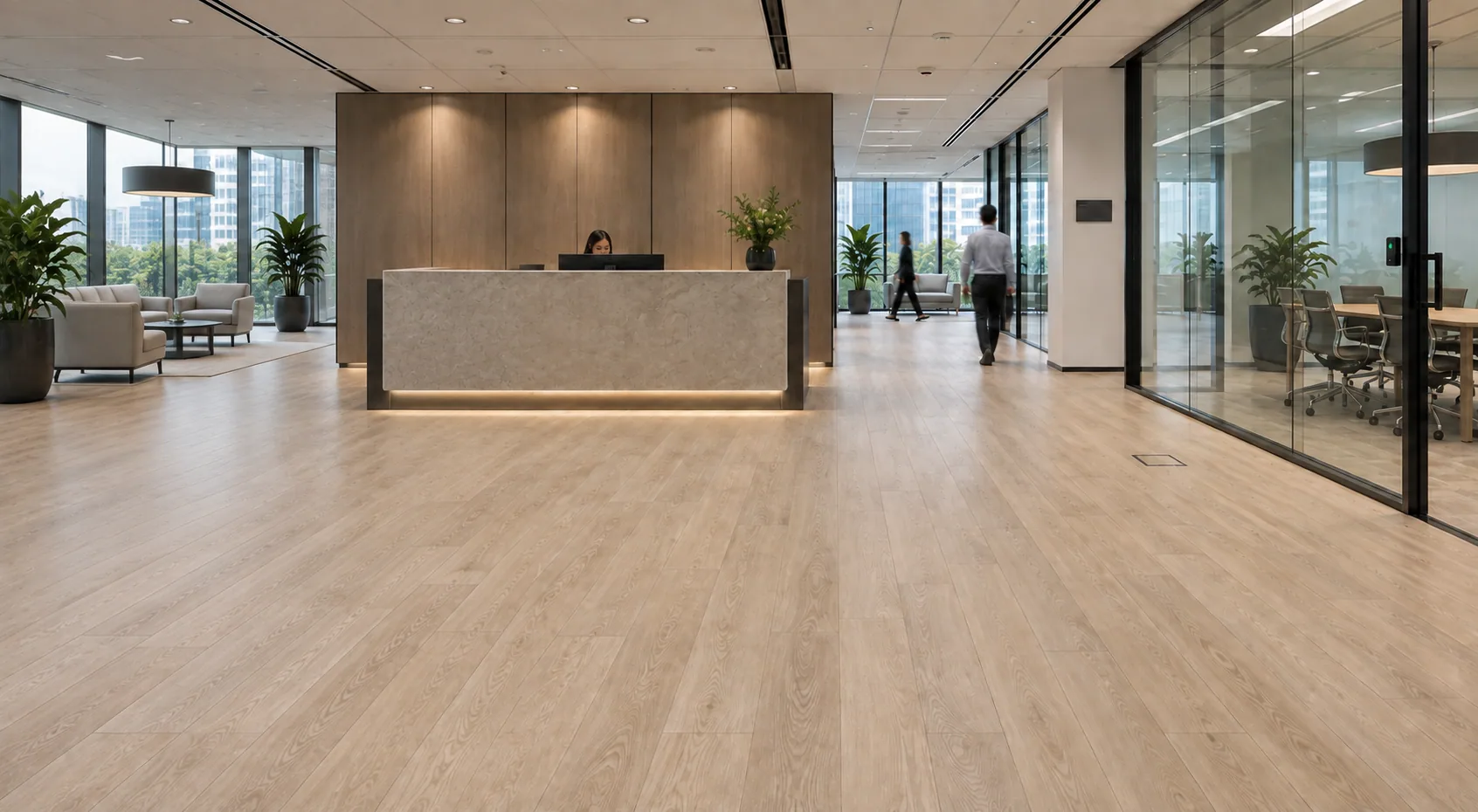
Where it goes decides
One specification, three different answers
The same plank can be fine in an open office, fine in the corridor outside it, and not allowed at all in the escape staircase next door. The Fire Code asks about the building and the location before it asks about the product.
Reading a datasheet
The answer is usually true. It is answering a different question.
Very little of what appears on a flooring datasheet under the heading of fire is false. It is that the test being reported is often the one that governs a wall, printed on a page about a floor, in a market where the difference is rarely checked.
What a datasheet usually offers
- A BS 476 Part 7 class, which SCDF describes as a method of classification appropriate to wall and ceiling linings
- The words fire retardant or fire resistant, with no standard, no class and no test report number behind them
- SCDF approved or SCDF certified, which no product is: SCDF regulates the scheme, accredited certification bodies issue the certificates
- A certificate covering a different model, backing or thickness in the same product range
What the Fire Code asks about a floor
- The finished thickness of the product as installed, against the 10mm and 20mm thresholds in Tables 3.15D and 3.15F
- Where the floor is going, because a plastic floor finish in an exit staircase or exit passageway is not allowed at all
- A result on one of the named routes: a Euroclass floor rating such as Cfl-s1, or a critical radiant flux figure from ASTM E648 or NFPA 253
- Whether the building is sprinkler-protected and whether it is a sleeping occupancy, because that is what sets the required class
Two smaller things are worth carrying into that reading. The first is that a floor finish is allowed to be combustible. SCDF's explanatory note to Clause 3.3 states that, with the exception of fire protecting suspended ceilings, surface materials for walls and ceilings and floor finishes can be combustible if they are not relied on to contribute to the fire resistance of the wall or floor. A floor's fire resistance is a property of the structure, not of the covering laid on top of it, which is precisely what fire rated flooring marketing tends to blur.
The second is arithmetic rather than a statement by SCDF, so treat it as a way of understanding the two routes rather than as a rule. Table 3.15A's American criterion, a critical radiant flux above 0.45 W/cm2, converts to 4.5 kW/m2. That is exactly the critical flux threshold the European system sets for Class Cfl in Commission Delegated Regulation (EU) 2016/364, read on 13 September 2026. The two routes are calibrated to broadly the same place, which is why the Code is content to accept either.
One claim in circulation is worth naming, without naming who is making it. You will see it stated in this market that SCDF requires Class B1 or equivalent. B1 is a German DIN 4102 classification. It does not appear in the Fire Code clauses and tables that govern floor finishes, which are Clause 3.13, Clause 3.15, Tables 3.15A, 3.15D and 3.15F, and Table 11A. That is a reason to check the claim against the clause before you specify to it, not a reason to assume bad faith.
The document that counts
The Certificate of Conformity, and who carries the risk
Table 11A of the Fire Code 2023 lists, at item 34, plastic finishing material for floor. Its acceptable standards column points straight back at Clause 3.15.19 for the testing requirements, and its certification scheme is Scheme 2. That is what makes the certificate question a normal one to ask on a flooring package rather than an unusual demand.
Who issues it, and who does not
- Clause 11.3.4a: regulated fire safety products used in fire safety works shall be certified by a local certification body accredited by SAC, the Singapore Accreditation Council. SCDF does not issue product certificates itself, which is the whole reason no product is SCDF approved. SCDF publishes the list of accredited certification bodies on its own site, and that list can change, so read it there rather than accepting a supplier's assurance that their certifier is on it.
How long it lasts, and the date it has to be valid on
- Clause 11.3.3b: a Certificate of Conformity for a regulated fire safety product is valid for 5 years from the date of issuance. Clause 11.3.3d judges validity at the date of delivery to the project site, and prohibits products whose certificates are suspended, terminated, expired or withdrawn on that date. The same clause points to the certification bodies' own online directories as where status is verified. There is no single consolidated public register covering all of them, so the check is per certifier.
What has to sit behind it
- Clause 11.3.4b requires test reports from laboratories accredited by SAC or recognised by SAC through the ILAC mutual recognition arrangement. Clause 11.3.5 requires the application behind a certificate to carry the brand and model, the density, weight and dimensions, the test report reference number, the version year of the test standard, the test outcome, and documentation that the laboratory's accreditation scope covers that specific test. Clause 11.3.5a requires the certificate itself to bear SAC's accreditation mark. Accreditation is scoped, so a laboratory can hold it for some tests and not for the one on your report.
What Scheme 2 actually buys you
- Clause 11.2 defines Scheme 2 as type testing of a sample during initial certification, followed by surveillance testing of samples taken from the market, meaning a warehouse or a project site. Table 11A adds that for plastic floor finishes the annual surveillance test is based on Clause 3.15.19. That is a materially different thing from a single test at product launch, and a completely different thing from an unsupported fire retardant claim on a brochure.
Who the law holds responsible
- On a project with a Qualified Person, Clause 11.7 makes the QP the one who verifies that regulated fire safety products have valid Certificates of Conformity and that the certificates match exactly with the products used. Under Part 5 of the Fire Safety Act 1993, the offence of installing a non-compliant fire safety product attaches to the owner or builder of the building. A supplier's exposure is on the supply side, for representing a non-compliant product as compliant. The practical consequence is that you cannot push this risk down the chain with a clause in a subcontract, and that the Act's own reasonable steps defence rewards a documented check made at the point of delivery.
One thing this article will not tell you, because we could not establish it. Table 3.15D exempts a plastic floor finish not exceeding 10mm, or 20mm in sprinkler-protected premises, from the Table 3.15A tests. Separately, Table 11A lists plastic finishing material for floor as a regulated fire safety product, and Clause 11.3.1 says all regulated fire safety products shall be certified and have valid CoCs before they can be used on or in buildings as part of fire safety works. Whether a thin, test-exempt vinyl still needs a certificate is not something we found an SCDF statement on, and it is not something we are going to guess at on a page about fire safety. Ask for the certificate. If the answer is that the product is exempt on thickness grounds, ask for that reasoning in writing.
Put it in writing
Six questions to send your flooring supplier
Each one comes straight out of a clause above. Send them by email rather than asking over a phone call, and keep the reply. The point is not to catch anyone out. It is that all six are answerable, and an answer that avoids the question is itself the finding.
-
What is the finished thickness of this product as installed?
Including any backing, underlay or build-up. This is the question that decides whether the Table 3.15A tests are required at all. The tables do not spell out whether the 10mm threshold is measured on the floor covering alone or on the whole build-up, so ask the supplier to state exactly what their figure includes rather than assuming it.
-
Is our building sprinkler-protected?
Strictly a question about the building rather than about the product, but it has to be settled before any class is quoted at you, because the required class under Table 3.15A category C moves with sprinkler protection and with whether the occupancy is a sleeping one. A supplier who names a class without asking this has not read the table.
-
Is any of this flooring going into an exit staircase or an exit passageway?
A drawings question, and the only one on this list with a fixed answer. If it is, the specification has to change, because Tables 3.15D and 3.15F do not allow a plastic floor finish in a protected escape route at any test result. Better to find this in the tender than on site.
-
Is there a current Certificate of Conformity for this exact brand, model and thickness?
Ask for the certificate number, the issuing certification body and the expiry date. Clause 11.7 requires certificates to match exactly with the products used, and Clause 11.3.5 requires brand, model and dimensions on the application behind them, so a certificate for the 2mm homogeneous sheet does not cover the 4mm acoustic-backed version of the same range.
-
Which standard, which version year, and which laboratory?
A certificate rests on a test report. Ask which standard the product was tested to, which year's version of that standard, which laboratory issued the report, and whether that laboratory is SAC-accredited or ILAC recognised for that specific test. A very old report behind a fresh certificate is worth a question too, since Clause 11.3.2 caps report age at the point of certification.
-
Will the certificate still be valid on the delivery date?
Validity is judged at the date of delivery to site under Clause 11.3.3d, not at the date of the quotation, and certificates run five years from issuance. On a long fit-out programme that is a real question rather than a formality, and the status can be checked against the issuing certification body's own online directory.
There is a seventh question you ask yourself rather than the supplier, and it is the one that closes the loop: who on this project is actually going to verify the answers. On a job with a Qualified Person, that is the QP's duty under Clause 11.7 and the flooring certificate should be routed to them with their confirmation in writing. On a fit-out without one, nobody is performing that check unless you do.
Where we stand
What a flooring contractor can and cannot tell you about this
This article is about the rules, not about our products, and that distinction is the point rather than a hedge. A great deal of the confusion in this market comes from a contractor being asked to act as the certifying authority, and then obliging.
We do not describe our own work as SCDF compliant
- No contractor's word is the evidence here, ours included. The evidence is a Certificate of Conformity issued by an SAC-accredited certification body, and it belongs to the product and its manufacturer rather than to whoever installs it. A contractor telling you their floor is SCDF approved is describing a thing that does not exist, which is a reason to check the rest of their paperwork rather than to relax about it.
A manufacturer's document is passed on as the manufacturer's
- Where a product carries a certificate, that certificate belongs to the product and the company that makes it, and it gets named that way wherever it appears on this site. A supplier's document is not a contractor credential and we do not present one as ours. Material warranties follow each manufacturer's own terms and are passed on to you directly.
The building questions are answered by looking at the building
- Whether a space is sprinkler-protected, and whether any part of the floor runs into a protected escape route, are questions about the building and its approved plans rather than about a datasheet. They are settled by reading the drawings and walking the space, which is what a site visit is for. Site visits are free and a written quote follows within 48 hours.
One project manager, so the question goes to one place
- On commercial work, electrical, plumbing, partition, glass, hacking and carpentry sit under the same project manager as the floor. When a specification question needs an answer from outside, you have one contact chasing it rather than five companies pointing at each other while a handover date moves.
What we do stand behind is the workmanship
- Our craftsmen are on our own payroll, the same crew prepares the substrate and lays the finish, and workmanship is warranted for one year after handover. That is our own credential and it is the only one we claim on this subject. The fire performance of a material is the manufacturer's to evidence and a certification body's to certify, and we would rather say so plainly than borrow a claim we cannot stand behind.
Questions worth asking
Before you specify
The five that come up most often on a commercial package, answered from the clause rather than from the brochure.
Does vinyl flooring need to be fire rated in Singapore?
- Not in the sense most people mean by fire rated. The Class 0 to Class 4 flame spread system is a wall and ceiling system in the Fire Code, and its governing table is titled minimum flame-spread classification of finishes to wall, column, beam and ceiling. A vinyl floor is regulated instead as a plastic floor finish under Clause 3.15.19. At or below 10mm, or 20mm in sprinkler-protected premises, Table 3.15D does not require the Table 3.15A fire tests. Above that thickness the product has to pass test categories A, B and C.
Is a Class 0 or BS 476 Part 7 rating the right one for a floor?
- It is not the test the Fire Code uses to control a plastic floor finish. SCDF describes BS 476 Part 7 as a method of classification appropriate to wall and ceiling linings, and it does not appear in Table 3.15A, which is where the fire tests and acceptance criteria for plastic floor material and finishes sit. A supplier who answers a floor question with a wall class has answered a different question.
Can vinyl flooring be laid in a fire escape staircase?
- No. Tables 3.15D and 3.15F both carry the same row: use in exit staircase or exit passageways, not allowed, key escape routes shall be protected. Clause 3.13.4 requires wall, ceiling and floor finishes to an exit staircase, including an exit passageway, to be of non-combustible materials or Class 0 where sprinkler-protected. No test result and no certificate changes this one.
What certificate should I ask a flooring supplier for?
- A Certificate of Conformity for that exact brand, model and thickness, with the certificate number, the issuing certification body and the expiry date. Clause 11.3.4a requires certification by a local certification body accredited by SAC, Clause 11.3.3b makes a certificate valid for five years from issuance, and Clause 11.3.3d judges validity at the date of delivery to the project site. Clause 11.7 requires the certificate to match exactly with the product used.
Does a thin vinyl still need a Certificate of Conformity if it is exempt from testing?
- We do not know, and we are not going to guess. Table 3.15D exempts a plastic floor finish not exceeding 10mm, or 20mm in sprinkler-protected premises, from the Table 3.15A tests. Separately, Table 11A lists plastic finishing material for floor as a regulated fire safety product, and Clause 11.3.1 says all regulated fire safety products shall be certified and have valid CoCs before they can be used on or in buildings as part of fire safety works. We could not find an SCDF statement reconciling those two. Ask for the certificate anyway, and if the answer is that the product is exempt on thickness grounds, ask for that reasoning in writing.
Check it yourself
The primary sources this page is built on
Every regulatory statement above comes from one of these, all read on 13 September 2026. If you are making a specification decision, read the clause rather than this page: SCDF amends the code continuously, and older editions are still online and easy to cite by accident.
-
Fire Code 2023, Clause 3.13, Classification of Spread of Flame
The Class 0 to Class 4 flame spread system, the wall and ceiling scope it applies to, and the escape route requirement at Clause 3.13.4. -
Fire Code 2023, Clause 3.15, Materials for Construction
Clause 3.15.15 on plastic material in walls, ceilings, floors, roofs and finishes, and Clause 3.15.19 on plastic floor finishes specifically. -
Fire Code 2023, Chapter 3 related tables
Table 3.13A, Table 3.15A, Table 3.15D and Table 3.15F in full: the flame spread table, the fire tests and acceptance criteria, and the conditions of use for plastic floor finishes. -
Fire Code 2023, Clause 3.3, Fire Resistance of Elements of Structure
The explanatory note stating that floor finishes can be combustible where they are not relied on to contribute to the fire resistance of the wall or floor. -
Fire Code 2023, Clause 11.3, Assessment and Validation
How Certificates of Conformity work: who issues them, how long they last, the date validity is judged on, and what has to sit behind them. -
Fire Code 2023, Clause 11.7, Requirements and Responsibilities for Qualified Persons
The Qualified Person's duty to verify that certificates are valid and that they match exactly with the products used. -
Fire Code 2023, Table 11A, regulated fire safety products and materials
Item 34 is plastic finishing material for floor, certification Scheme 2, with its testing requirements pointed back at Clause 3.15.19. -
Regulated fire safety products and the Product Listing Scheme
SCDF's own page on the scheme, including the live list of accredited certification bodies. That list changes, so read it here rather than anywhere else. -
Fire Safety Act 1993, Part 5, Fire safety products
The supply and installation offences for fire safety products, and the definition of the person on whom the installation offence falls. -
Commission Delegated Regulation (EU) 2016/364
Where the Bfl, Cfl and Dfl floor classes and the s1 smoke suffix come from, with the critical flux threshold behind each one.
Where this goes next
Specification questions belong in the site visit, not the handover
The thickness, the location and the paperwork are all decided before anything is ordered. If you are specifying a floor for an office, a shop or a restaurant, that is the conversation to have while the drawings are still open.
More from the blog
Related reading
Specification, coordination and the questions worth settling before a commercial floor is ordered rather than after it arrives.
-
Why coordinating five subcontractors on a commercial fit-out usually goes wrong
The floor is rarely the problem. It is the handoff between trades, where nobody owns the junction, and where a paperwork question quietly becomes nobody's job. -
Vinyl wear layer explained: 0.3mm, 0.5mm and 0.7mm compared
The other specification number that gets quoted loosely. What each wear layer tier is built for, and where commercial traffic actually needs it. -
All guides
Every real guide on this site, from the Eben Solutions craft house.

Let's build a brighter space together
Ready to transform your space?
Book a site visit and let's discuss your renovation needs.
Book a site visit- Free site assessment
- No obligation quote
- Singapore islandwide