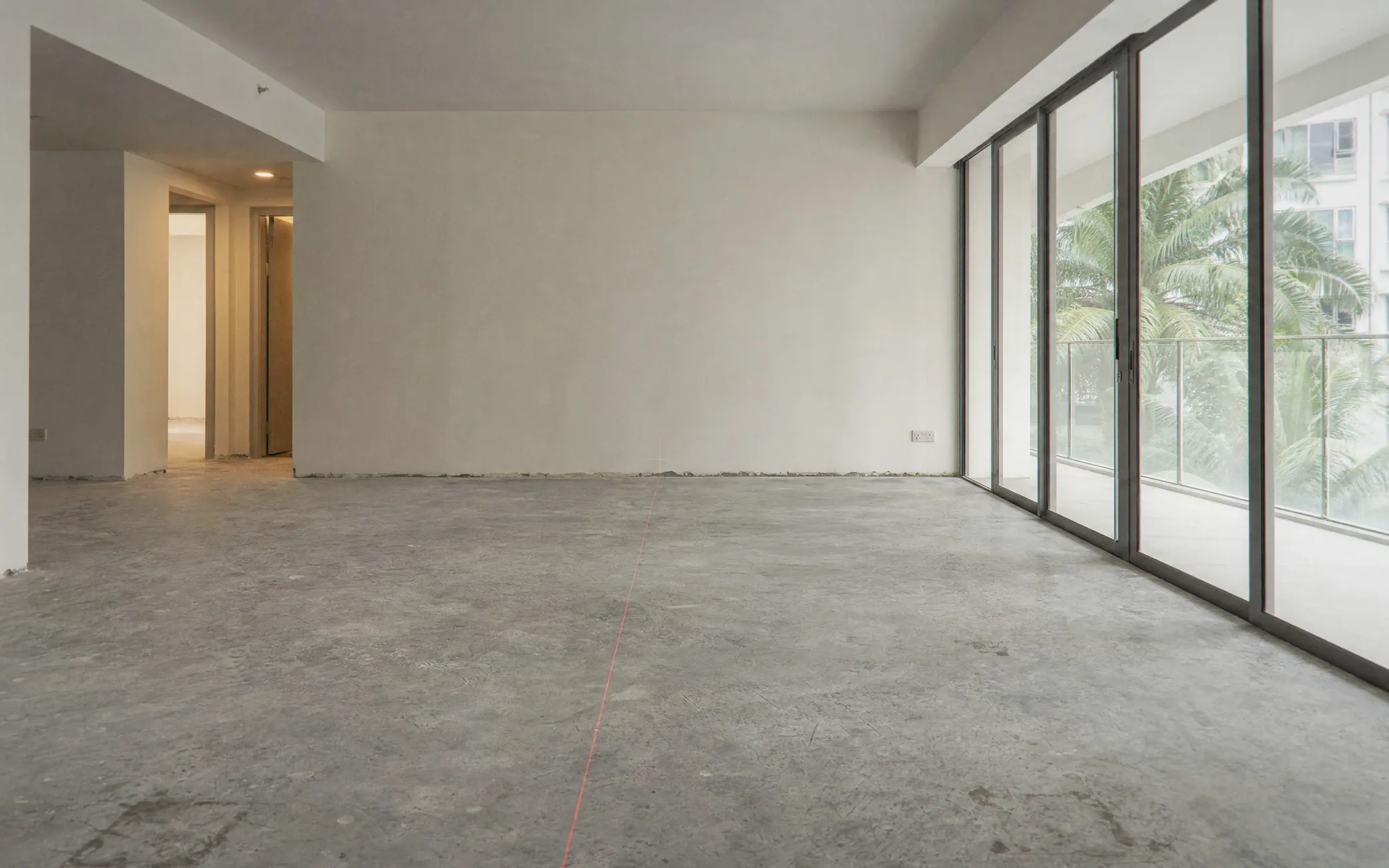
Foundation
Do you need to waterproof before laying vinyl or microcement in Singapore?
Only where there is a reason to. Wet areas, balconies and a damp screed all fail the same way under a floor that was never waterproofed, and the finish is the wrong place to find that out.
The short answer
Yes, in every wet area and on any screed that fails its own moisture test
A bathroom, a kitchen wet zone, a balcony, a planter box and a roof deck all need a proper membrane before any finish goes on, no exceptions. A living room or bedroom on a dry, tested screed usually does not. The difference is not the finish you have chosen, vinyl and microcement both fail the same way over a substrate that was never checked: it is whether the substrate underneath has water in it or a route for water to reach it, and the only honest way to know that is to test it rather than guess from how it looks.
Before the floor goes down
Where waterproofing is not optional
These are not judgement calls. If a space falls into one of these, it gets a membrane before it gets a floor, whichever finish is going on top of it.
Bathrooms and wet zones
Showers, wash areas and any kitchen zone that gets standing water. The membrane runs across the floor and up the walls, not just underfoot.
Balconies, planters and roof decks
Exposed to rain directly, with a slab that usually sits over occupied space below. There is no dry season long enough to skip this.
Ground floor slabs and rising damp
A slab in contact with the ground can carry moisture upward long after the building itself is finished, whatever floor above it assumes.
Any screed that fails its own test
Relative humidity and surface readings taken before the floor is specified. A reading outside the safe range gets a membrane, whatever room it is in.
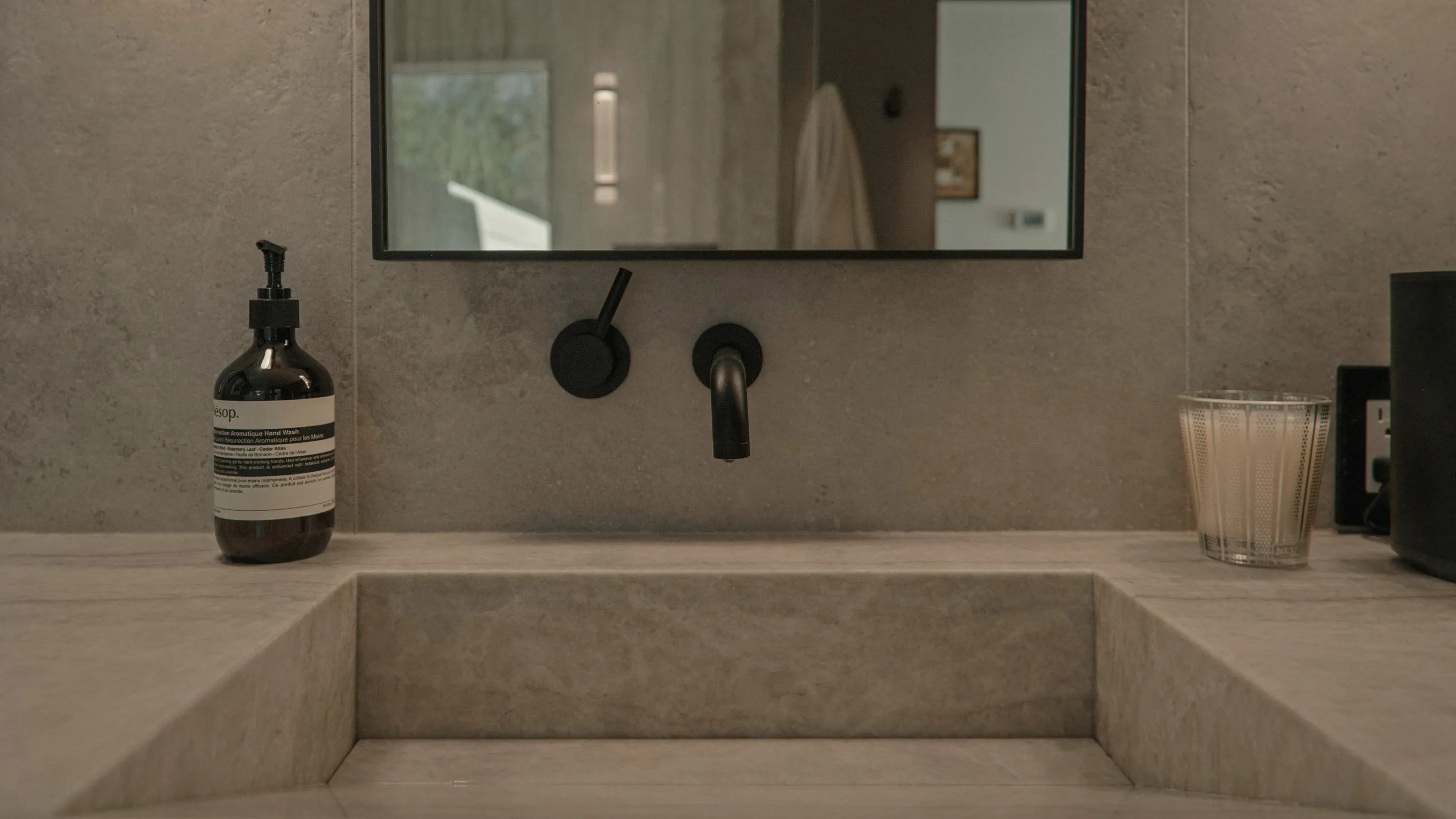
Wet areas
The membrane goes on first, whatever finish sits on top
A seamless microcement basin or a vinyl-look plank floor both read as finished the day they are installed. Whether either one is still sound in five years was decided underneath it, before the finish ever went on.
What skipping it costs you
The failure looks different. The cause is the same.
Neither material is more forgiving of a damp or unwaterproofed substrate than the other. They just fail in ways that suit what each one is.
Vinyl over a damp substrate
- Moisture trapped underneath has nowhere to go once the plank seals over it
- Click-lock joints are the first thing to open and cup
- A glue-down system loses its bond from underneath, not from the surface
- In a wet area, water finds the seams long before the wear layer wears through
Microcement over a damp substrate
- A 2 to 3mm coating cannot bridge a substrate that is still moving or still wet
- Trapped moisture pushes up through the coating as it tries to dry
- Microcement was never a waterproofing layer to begin with
- A shower or balcony finished without a membrane fails at the coating, not the concrete
Neither of these shows up on handover day. That is what makes it worth checking before, not after.
How Eben handles it
One crew for the membrane, the level and the floor
The same team that tests, waterproofs and levels a substrate also lays the finish that goes on top of it, coordinated by one project manager. Nobody is inheriting a problem someone else signed off on.
Moisture testing, before anything is specified
- Relative humidity and surface readings taken before the floor or the finish is even chosen, so a damp screed never quietly becomes a lifted plank or a cracked coating months after handover.
Waterproofing, before the levelling
- Wet-area, balcony, roof and planter membrane systems: sheet, PU and cementitious, matched to the substrate and the load. This goes on before the self-levelling compound, not after and not instead of it.
Self-levelling, to a checked tolerance
- ARDEX K 310, a self-levelling compound from ARDEX-QUICSEAL Singapore, laid at 3 to 8mm to the manufacturer's own preparation specification and laser-checked flat to plus or minus 2mm. It holds Singapore Green Building Product certificate SGBP 3694, valid until 9 December 2026. That certificate belongs to the product and its manufacturer, not to Eben, and it says nothing about Eben's own workmanship.
One team, one warranty
- The people who test the moisture, install the membrane and lay the finish are on Eben's own payroll, not a subcontracted chain. Workmanship is warranted for one year after handover; material warranties follow each manufacturer's own terms and are passed on directly.
Questions worth asking
Before you sign
The questions a quotation should be able to answer, before the floor is chosen rather than after.
Do you need to waterproof before laying vinyl flooring in Singapore?
- Only where there is a reason to: a wet area, a slab in contact with the ground, or a moisture reading that fails a proper test. A dry, tested screed in a living room or bedroom does not need a membrane. It still needs the test, because that is the only way to know it is dry rather than assume it.
Does microcement waterproof a bathroom by itself?
- No. Microcement is a 2 to 3mm decorative and functional coating, not a waterproofing layer. In a shower or on a balcony it goes over a proper membrane system that is installed and tested first. A microcement surface with no membrane underneath looks the same on day one and fails at the substrate later.
What kind of waterproofing does Eben Solutions use?
- Sheet, PU and cementitious membrane systems, matched to the substrate and the load: a planter box, a roof deck and a shower recess are different problems and are not all solved by the same system.
How long does waterproofing add to a flooring renovation timeline?
- The membrane itself has its own manufacturer-specified drying time before anything goes over it. After that, ARDEX K 310 is walkable in 3 to 4 hours and ready for a floor covering after 48 hours at 3mm thickness. A programme with the floor going down the morning after levelling is not a fast programme, it is a wrong one.
How do I know if my existing floor already has a moisture problem?
- Relative humidity and surface moisture readings, taken before any floor is specified, not guessed at from how the screed looks or feels. A damp screed does not announce itself; it becomes a lifted plank or a cracked coating months after the crew has left.
Where this goes next
Vinyl or microcement, the foundation comes first
Whichever finish you are weighing, the substrate underneath it is the same decision. Eben tests it, waterproofs it and levels it before either one goes down.
More from the blog
Related reading
The substrate work this article covers is the same argument the rest of the site makes about surfaces: what's underneath decides what lasts.
-
Vinyl wear layer explained: 0.3mm, 0.5mm and 0.7mm compared
The wear layer, not the plank's total thickness, decides how long a vinyl floor survives. What each tier is built for, and where it belongs room by room. -
All guides
Every real guide on this site, from the Eben Solutions craft house.

Let's build a brighter space together
Ready to transform your space?
Book a site visit and let's discuss your renovation needs.
Book a site visit- Free site assessment
- No obligation quote
- Singapore islandwide